

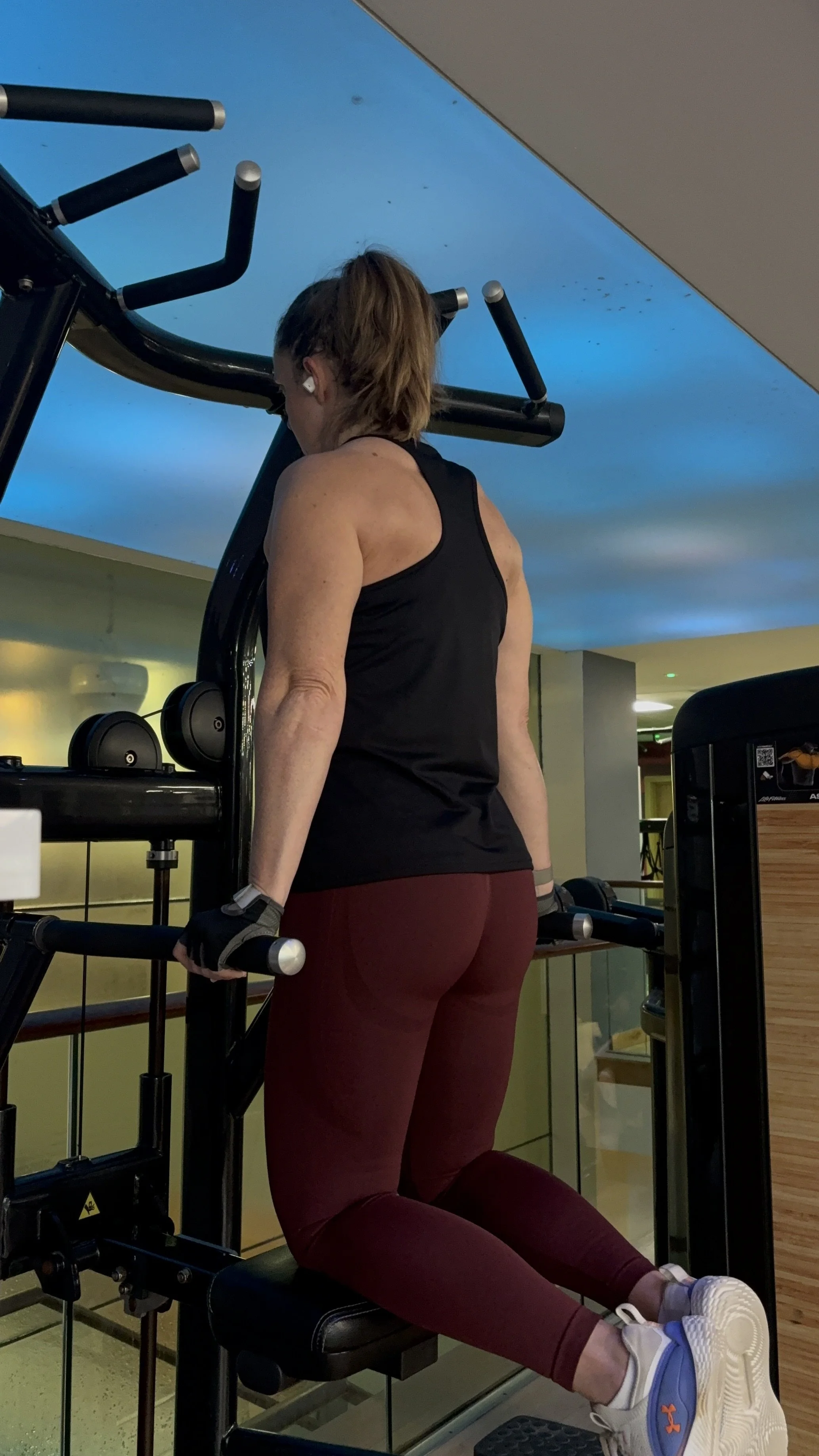
Why progress isn't always visible, especially when you're just starting out.
When we start exercising, it's natural to want to see results. We step on the scales, look for changes in the mirror or wonder whether our clothes are fitting differently.
But what happens when those changes aren't there?
Does that mean our training isn't working?
It's something I think about a lot when coaching women who are new to strength training. Because some of the most interesting changes I see have very little to do with how someone looks.
They're lifting weights they wouldn't have considered picking up a few weeks earlier. Their movements are becoming more controlled. They're beginning to understand how their body moves and how to challenge themselves.
And quite often, I notice these changes before they do.
What's actually happening when we start strength training?
One of the things worth understanding is that getting stronger and building muscle aren't quite the same thing.
When you first begin resistance training, your body is learning something new.
Your nervous system becomes better at coordinating the muscles involved in a movement. You begin to develop the technique and control needed to perform an exercise more effectively.
This means you can become stronger before there's a noticeable increase in muscle size.
Think about learning to squat.
In your first session, you might be concentrating on where to position your feet, how far to lower yourself and how to keep your balance.
A few weeks later, that same movement might feel much more natural. You may be able to squat a little deeper, move with better control or hold a heavier weight.
That's progress, even if nothing has changed on the scales.
What does the research say?
In March 2026, the American College of Sports Medicine (ACSM) published an updated position stand on resistance training.
It brought together findings from 137 systematic reviews involving more than 30,000 participants.
The researchers found that resistance training improved muscular strength, muscle size, power, endurance, balance and several measures of physical function.
What I found especially interesting was that the benefits weren't restricted to one particular way of training.
Resistance bands, bodyweight exercises, free weights and home-based training could all contribute to improvements.
The research also suggested that many of the more complicated training methods we hear about aren't essential for most people to make progress.
For someone just starting out, that's an important message.
You don't need to understand every exercise, lift heavy weights straight away or follow an elaborate programme.
You need to learn the movements, train consistently and gradually increase the challenge as your strength develops.
What about building muscle after menopause?
This is another question I hear regularly.
Can we still build muscle in our 40s, 50s, 60s and beyond?
The answer is yes, definitely.
A 2024 systematic review and meta-analysis examined resistance training and muscle growth in postmenopausal and older women.
The analysis included 14 randomised controlled trials and compared different amounts of resistance training with control groups.
Both lower-volume and higher-volume training were associated with improvements in measures of muscle mass, with the higher-volume programmes showing greater gains.
There are some limitations to the research, including the relatively small number of studies and low certainty of evidence. So we shouldn't interpret the findings as a guarantee of how much muscle any individual woman will gain.
But the broader message is encouraging.
Muscle can respond to resistance training after menopause.
And while doing more training may support greater muscle growth, that doesn't mean someone new to strength training needs to start with a demanding programme.
In fact, I'd argue that learning how to train well, understanding effort and establishing a routine are far more useful starting points.
The amount of training can develop as confidence, strength and experience increase.
The changes I see when coaching women
I've now coached many women through my four-week Learn to Lift programme, alongside women who work with me individually.
And one of the things I enjoy most is seeing how differently they progress.
For one woman, it might be performing her first controlled press-up against a bench.
For another, it's discovering that she can squat while holding a weight.
Sometimes it's something much less obvious!
A woman who was hesitant to pick up a dumbbell in her first session is now choosing a weight for herself. Someone who needed regular reassurance about her technique is beginning to recognise when a movement feels right.
These aren't dramatic transformations.
They're small changes that build on one another.
I also use some straightforward physical assessments with my individual clients, including how many times they can stand from a chair in 30 seconds, how long they can hold a plank or how many controlled incline press-ups they can perform.
When we revisit these assessments, the results can help women recognise improvements they might otherwise have missed.
Of course, not every measure improves every time. Progress isn't always linear, and sleep, stress, recovery and other aspects of life can influence performance.
But having something to look back on can make a real difference to how someone understands their progress.
What if the scales aren't changing?
It's worth remembering that changes in strength, muscle mass and body fat are three different things.
You can improve your strength without a substantial increase in muscle size.
You can build muscle without losing body fat.
And you can experience changes in body composition without seeing much movement on the scales.
The number on the scales cannot tell you how much stronger you've become, whether your balance has improved or how confidently you can perform an exercise.
That doesn't mean body composition goals are wrong. Some women want to build muscle, reduce body fat or change how their body looks, and those are perfectly reasonable goals.
But I think it's important that we don't overlook the other benefits of strength training while waiting for visible changes.
Especially when we're just beginning.
So how can you recognise progress?
Rather than relying entirely on appearance or weight, consider what you're actually doing in your training.
Are you able to lift a slightly heavier weight than you could a month ago?
Can you complete more repetitions with good technique?
Do you feel more controlled when squatting, pushing, pulling or lifting something from the floor?
Are you beginning to understand which weights challenge you and when it's time to progress?
And perhaps just as importantly, are you becoming more confident about training independently?
These are all worthwhile things to pay attention to.
You don't need to track everything. Keeping a record of a few exercises and reviewing them over time can help you see whether your training is moving in the right direction.
Give yourself time to learn
One of the reasons I developed Learn to Lift was because I wanted women to have the opportunity to understand strength training before feeling they needed to master it.
Four weeks isn't enough time to learn everything, and it certainly isn't a deadline for achieving visible physical changes.
But it can be enough time to start developing movement skills, discover what you're stronger at than you expected and begin to understand how to progress.
And those early experiences matter because the aim isn't just to get through four weeks of exercise.
My aim for the women who put their trust in me is to develop the knowledge and confidence to keep going.
So if you've recently started strength training and you're wondering whether it's working, don't just look in the mirror.
Think about what you can do today that you couldn't do when you started.
You might be making more progress than you realise!
Research references
1. Currier, B. S., et al. (2026). American College of Sports Medicine Position Stand: Resistance Training Prescription for Muscle Function, Hypertrophy, and Physical Performance in Healthy Adults: An Overview of Reviews. Medicine & Science in Sports & Exercise, 58(4), 851–872.
https://pubmed.ncbi.nlm.nih.gov/41843416/
2. Nunes, P. R. P., et al. (2024). Higher volume resistance training enhances whole-body muscle hypertrophy in postmenopausal and older females: A secondary analysis of systematic review and meta-analysis of randomized clinical trials. Archives of Gerontology and Geriatrics, 124, 105474.
https://pubmed.ncbi.nlm.nih.gov/38744142/
At The Stillpoint®, I work with women in midlife who want to learn how to strength train, understand their bodies and develop the confidence to continue. My four-week Learn to Lift programme introduces the foundations of resistance training in a small, supportive group, with a maximum of three women.
